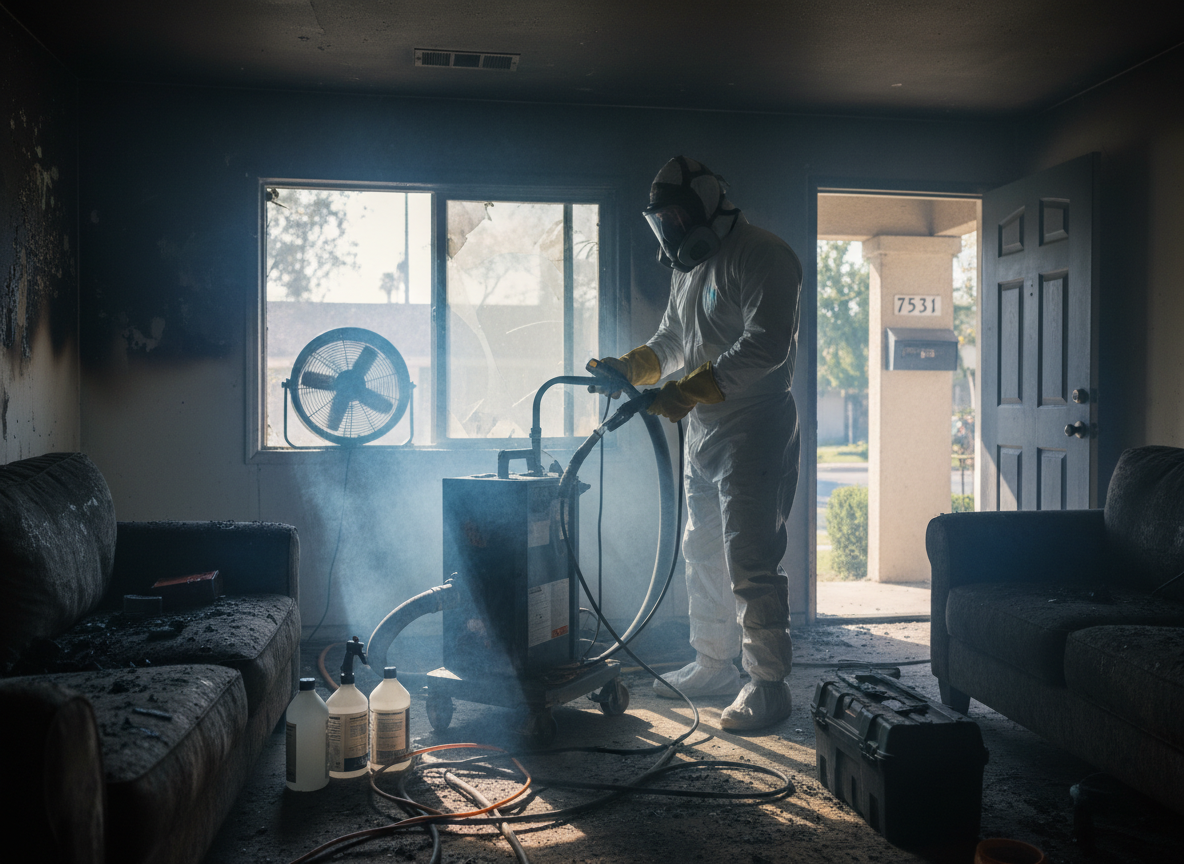
In Reseda’s older housing stock near Reseda Park, smoke from structure fires often travels through shared walls and attic spaces into neighboring units, especially during the hot dry summers when low humidity lets odors bind tightly to drywall, insulation and hardwood floors. Technicians must map airflow paths created by the area’s typical post-1950s construction before any treatment begins, or residual smells will reappear once temperatures climb again.
Porous materials common in Lake Balboa and Woodland Hills homes, such as textured plaster and carpet padding, trap volatile organic compounds from burning plastics and synthetic furnishings. Standard ozone or fogging alone rarely reaches these layers; instead, source removal of affected subflooring and repeated thermal fog applications timed to evening humidity spikes are required to break the odor cycle without damaging the Mediterranean-climate stucco exteriors.
Los Angeles County air-quality rules limit certain solvent-based deodorizers near Westfield Topanga and busy corridors, so crews rely on activated charcoal filtration units and hydroxyl generators that run continuously for days. Homeowners who attempt DIY sprays often spread particulates into HVAC systems that serve multiple Van Nuys-adjacent blocks, turning a contained job into a multi-unit remediation.
Final clearance testing includes both olfactory inspection and air sampling at multiple points inside the home, because summer winds can push lingering smoke back through vents days after visible soot is gone. Only when readings stay below threshold for 48 hours is the space released.
Technician insight
In Reseda the thing that catches most people out with odor removal after fire is how the hot dry summers let smoke ride the low humidity straight into the paper backing of drywall in 1960s homes near Victory Boulevard; if you don’t pull that layer the smell returns the first time the Santa Ana winds blow.
Smoke trapped in shared attic
A fire in a Reseda duplex sent smoke into the common attic space shared with the neighboring unit. Inspection showed odor had penetrated insulation above both ceilings. Crews removed the contaminated insulation, ran hydroxyl units for three days during the evening humidity window, then cleared the space after air sampling showed levels below threshold.
How it works
- 1
Initial Assessment
Technicians inspect all affected rooms, HVAC runs and attic spaces to locate odor reservoirs created by the fire’s path through Reseda’s typical wood-frame construction.
- 2
Source Removal
Burned and heavily contaminated materials such as insulation, carpet and drywall sections are cut out and disposed of before any masking agents are introduced.
- 3
Deodorization Application
Thermal fogging and hydroxyl generators are staged and run in cycles matched to evening humidity levels typical of the local Mediterranean climate.
- 4
Clearance Testing
Air samples and surface checks confirm odor elimination before the home is returned to the owner.
Pricing
Cost depends on square footage affected, number of rooms requiring source removal, and duration of equipment runtime. Upfront quotes provided after on-site inspection.