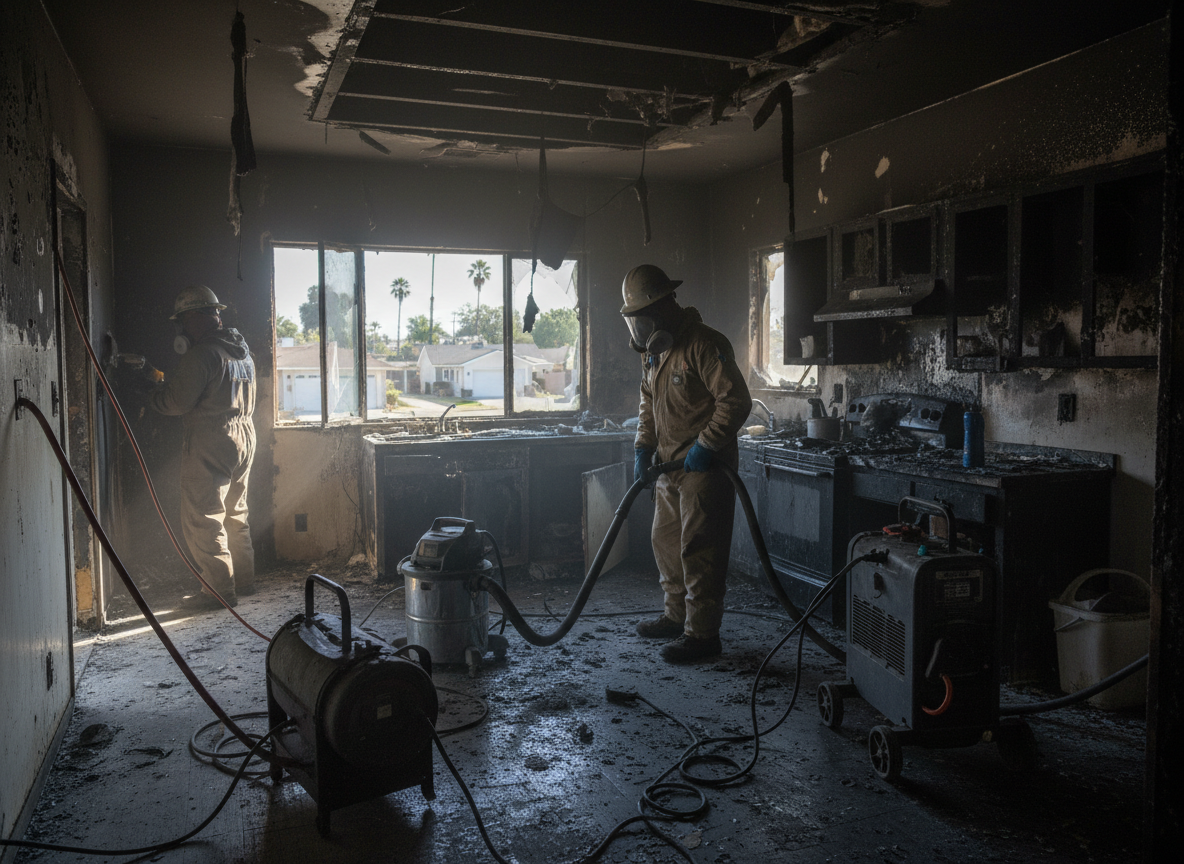
Reseda sits in the San Fernando Valley with a Mediterranean climate of hot dry summers that quickly turn small fires into major events. Older single-family homes built from the 1950s through the 1970s often feature stucco exteriors over wood framing and lath-and-plaster interiors. These materials allow smoke and soot to travel through wall cavities and attic spaces far from the original burn site, especially when summer winds push embers across neighborhoods near Reseda Park and Westfield Topanga.
Los Angeles County building codes require specific ventilation and electrical upgrades during any post-fire rebuild. Crews must test for hidden charring in roof sheathing and check whether knob-and-tube wiring survived heat exposure. In Lake Balboa and Van Nuys, slab-on-grade foundations can trap moisture from suppression water, leading to mold if drywall is not fully removed and dried within days. Technicians familiar with these conditions know to pull baseboards early and use moisture meters on concrete before closing walls.
Hot summer temperatures also affect equipment choices. Dehumidifiers and air movers must run longer to overcome low humidity that keeps soot airborne. Homeowners who attempt initial cleanup with household vacuums often spread fine particles deeper into carpet padding and HVAC ducts, raising the scope of work when professionals arrive.
Technician insight
In Reseda, the thing that catches most people out with Fire damage restoration near me is how the hot dry summers let smoke travel through the open attics of 1960s stucco homes near Lake Balboa. Homeowners often think wiping visible surfaces is enough, but the fine soot has already settled into insulation and behind baseboards, and once summer heat returns it reactivates the odor.
Attic Soot Migration After Kitchen Fire
A kitchen fire in a Reseda home near Reseda Park sent smoke into the attic shared with two bedrooms. We found soot had migrated through unsealed can lights and settled on fiberglass batts. After removing the insulation, running negative air machines for 72 hours, and replacing the affected drywall, the home passed clearance testing and the family moved back in without lingering odor.
How it works
- 1
Emergency Board-Up
Secure openings with plywood and tarps to prevent weather and vandalism damage while assessment continues.
- 2
Soot and Smoke Removal
Use HEPA vacuums, chemical sponges and air scrubbers to capture particles from surfaces, ducts and insulation.
- 3
Structural Drying and Demolition
Remove saturated drywall and insulation, then apply industrial drying to concrete slabs and framing.
- 4
Odor Neutralization
Apply thermal fogging and ozone treatments to neutralize smoke odors trapped in porous materials.
- 5
Rebuild and Final Clearance
Replace damaged sections to code and perform clearance testing before returning the property to the owner.
Pricing
Cost depends on square footage affected, depth of smoke penetration, and whether structural members require replacement.